Occupational Asthma Incidence Tracks Isocyanate Exposure in UK Auto Paint Shops
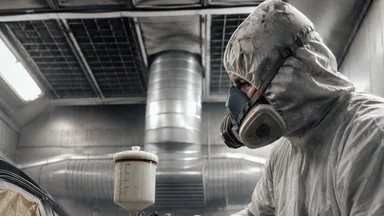
Inside a car body shop, the air carries a chemical signature that is invisible but potent. The spray booth, where a vehicle’s panels are refinished with two-pack polyurethane paints, becomes a reactor. The hardener — typically a diisocyanate such as hexamethylene diisocyanate (HDI) or toluene diisocyanate (TDI) — aerosolizes as the painter applies the coating. Despite ventilation systems and respirators, workers inhale concentrations that, according to UK Health and Safety Executive (HSE) data, can exceed workplace exposure limits in poorly controlled settings. Over weeks or months, this exposure can trigger a form of asthma that does not go away when the workday ends.
The Spray Booth and the Breath
Two-pack paints are widely used in automotive refinishing because they cure into a durable, glossy finish. The reactive chemistry that gives them this performance also makes them hazardous. When the paint is atomized through a spray gun, fine droplets containing isocyanate monomers and oligomers hang in the air. Workers in the booth, even with air-fed respirators, can inhale these particles. The HSE has measured peak exposures in independent bodyshops that exceed the UK workplace exposure limit of 0.02 mg/m³ for HDI — sometimes by a factor of ten or more during spray operations.
Sensitization can occur within months of starting the job, but it often goes unnoticed until symptoms become persistent. A painter may notice occasional wheezing or chest tightness after a shift, attributing it to a cold or a long day. Over time, the response to isocyanates becomes more pronounced. The immune system begins to treat the chemical as a threat, and each subsequent exposure triggers an inflammatory cascade in the airways.
The HSE’s Health and Safety Statistics for 2023/24 estimated that occupational asthma accounted for roughly 100 new cases per year in Great Britain, with isocyanates implicated in a significant proportion — some studies suggest 20–30% of all cases. The true number is likely higher, because many cases are misdiagnosed as non-occupational asthma.
Smaller body shops often lack the resources for proper ventilation. Local exhaust ventilation (LEV) systems, which capture paint mist at the source, are expensive to install and maintain. A 2022 HSE inspection initiative in the West Midlands found that nearly half of independent bodyshops had inadequate LEV. Workers rely instead on disposable respirators, which provide inconsistent protection, especially if not fit-tested or replaced regularly.
How Isocyanates Remodel the Airways
The biological mechanism of isocyanate-induced asthma is distinct from the allergic asthma triggered by pollen or dust mites. Isocyanates are low-molecular-weight chemicals that act as haptens — they bind to proteins in the lung tissue, forming a complex that the immune system misidentifies as a foreign invader. This triggers a type 2 helper T-cell response, leading to eosinophilic inflammation and the release of cytokines such as interleukin-4 and interleukin-13.
Chronic inflammation causes structural changes in the airways, a process called remodeling. The bronchial walls thicken due to smooth muscle hypertrophy and subepithelial fibrosis. Mucus glands enlarge, and the epithelium becomes fragile. These changes reduce the airway lumen and increase hyperresponsiveness — the tendency for the airways to constrict in response to minor triggers like cold air or smoke.
Unlike some forms of allergic asthma that can be managed with inhaled corticosteroids and avoidance of triggers, the remodeling in occupational asthma often becomes permanent. Even after removal from exposure, airway hyperresponsiveness may persist for years. A study in the European Respiratory Journal reported that more than half of workers with confirmed isocyanate asthma continued to have symptoms and abnormal lung function five years after leaving the trade.
The latency period between first exposure and sensitization varies widely. Some workers develop symptoms within weeks; others may work for decades before noticing a problem. This variability makes it difficult to predict who is at risk. Genetic factors, such as certain human leukocyte antigen (HLA) alleles, may influence susceptibility, but no screening test exists to identify vulnerable individuals before they start work.
Diagnostic Lag in the NHS Occupational Clinic
Diagnosing occupational asthma requires linking respiratory symptoms to workplace exposure, but this connection is often missed in general practice. The symptoms — cough, wheeze, chest tightness, shortness of breath — are indistinguishable from adult-onset asthma. Without a detailed occupational history, a GP may treat the condition as idiopathic asthma, prescribing inhalers that manage symptoms without addressing the cause.
Peak-flow diaries, where a patient measures their lung function multiple times a day and notes whether they are at work, can reveal a pattern of decline during the work week and improvement on days off. Yet many patients are not asked to keep such records. A 2021 audit of NHS primary care trusts found that fewer than one in five patients with suspected new-onset asthma had an occupational history documented in their notes.
Specific IgE blood tests for isocyanate allergy exist but are not routinely ordered. The test has moderate sensitivity — perhaps 50–70% — meaning a negative result does not rule out the condition. Specialized inhalation challenge tests, in which a patient inhales a low dose of isocyanate under controlled conditions, are the gold standard but are only available in a few occupational lung disease centers in the UK. Referral wait times for these centers can exceed six months, during which the worker continues to be exposed.
Early diagnosis and removal from exposure are critical. Studies suggest that workers who remain exposed for more than two years after symptom onset are more likely to develop persistent asthma and irreversible lung function decline. Yet the average delay from first symptom to diagnosis in the UK is estimated at 3–4 years, based on data from the Birmingham cohort discussed below.
Birmingham Cohort: Thirty Years of Follow-Up
The University of Birmingham has maintained a longitudinal cohort of workers diagnosed with occupational asthma since the early 1990s. Researchers have tracked more than 400 patients, many of them auto body painters exposed to isocyanates. The cohort provides some of the longest follow-up data on the natural history of the disease.
At diagnosis, the typical patient is in their late 30s or early 40s, has worked in the trade for about 15 years, and has had symptoms for roughly three years. Lung function at diagnosis is often already reduced, with a mean forced expiratory volume in one second (FEV1) around 80% of predicted. Over the subsequent five years, FEV1 declines at a rate roughly twice that of non-occupational asthma, even in those who have left the industry.
Nearly half of the cohort reported persistent symptoms and continued use of asthma medication five years after diagnosis. About one in four had a significant decline in lung function — a drop in FEV1 of more than 15% from baseline. Re-exposure was common, especially among workers who returned to small body shops after a diagnosis, often because they had no other job skills or because employers did not accommodate their condition.
The cohort also highlighted the socioeconomic impact. Many workers were unable to continue in their trade and faced income loss. A 2018 analysis from the group estimated that the annual economic burden of occupational asthma in the UK — including healthcare costs, lost productivity, and disability benefits — was in the range of £100–200 million, with isocyanate-related cases accounting for a substantial share.
The Regulation Gap in Independent Bodyshops
Large automotive manufacturers and their authorized repair networks typically enforce strict health and safety protocols. They install spray booths with ventilation systems that are regularly tested, provide workers with air-fed respirators, and conduct health surveillance — annual respiratory questionnaires and spirometry — as required by the Control of Substances Hazardous to Health (COSHH) Regulations. In these settings, exposure levels are generally kept below legal limits.
The gap lies in the independent bodyshop sector, which accounts for roughly 60% of the UK’s automotive refinishing businesses, according to industry estimates. These shops often operate on thin margins. Installing a compliant spray booth with LEV can cost £20,000 or more, and maintenance adds ongoing expense. Health surveillance is a legal requirement for workers exposed to isocyanates, but enforcement is inconsistent. HSE inspections of small workplaces have declined since the 2010 austerity cuts; the HSE’s field operations directorate now conducts around 1,000 proactive inspections per year across all industries, down from roughly 3,000 a decade ago.
Personal protective equipment (PPE) compliance is uneven. While air-fed respirators offer effective protection, they are uncomfortable for prolonged use, especially in warm conditions. Disposable half-mask respirators with organic vapor cartridges are more common but require a tight seal and proper fit. A 2023 study by the Institute of Occupational Medicine found that nearly 30% of workers in small body shops did not use respiratory protection during spray painting, and among those who did, many wore the wrong type or failed to replace cartridges.
Trade associations such as the National Body Repair Association have developed guidance and training programs, but membership is voluntary. Without mandatory certification or licensing for body shops, the regulatory patchwork leaves many workers unprotected.
Shift to Waterborne Paints: A Partial Solution
Major paint manufacturers, including PPG, Axalta, and BASF, have developed waterborne paint lines that contain lower levels of isocyanates or, in some cases, are isocyanate-free. These products use alternative cross-linking agents such as polyaspartic esters or blocked isocyanates that are less volatile. For large repair networks, the switch has been driven partly by environmental regulations — the EU’s VOC Solvents Emissions Directive has pushed for lower solvent content — and partly by health considerations.
Waterborne paints reduce, but do not eliminate, respiratory risk. The curing agents in some formulations still contain reactive amines or other sensitizers. Moreover, the spray application process still generates aerosols that can be inhaled. Ventilation and respirators remain necessary.
The cost premium for waterborne paints — roughly 10–20% higher than conventional solvent-borne two-pack paints — deters smaller body shops. Adoption rates in the UK lag behind those in continental Europe, where stricter VOC regulations and higher enforcement have accelerated the transition. In Germany, for example, waterborne paint use in automotive refinishing is estimated at over 80%, compared to perhaps 40–50% in the UK, according to industry sources.
Even with waterborne paints, the risk is not zero. A 2020 study in Occupational and Environmental Medicine found that workers using waterborne paints still had elevated rates of respiratory symptoms compared to office workers, though lower than those using conventional paints. The authors called for continued health surveillance and exposure monitoring regardless of the paint type.
What Surveillance Could Catch Earlier
Current health surveillance for workers exposed to isocyanates, as mandated by COSHH, typically includes an annual respiratory questionnaire and spirometry. However, the sensitivity of annual spirometry for detecting early disease is low. A worker can lose a significant amount of lung function before the FEV1 drops below the threshold that triggers a referral. More frequent and more sensitive methods are needed.
Serial peak-flow measurement over a two-week period, with readings taken four times a day and plotted alongside work and rest days, can reveal a work-related pattern. This is inexpensive but requires patient compliance and interpretation by an occupational health professional. The HSE recommends peak-flow monitoring for any worker with symptoms, but it is not systematically performed.
Methacholine challenge testing, which measures airway hyperresponsiveness, can identify borderline cases where spirometry is normal. It is more sensitive but requires a clinical setting and is not routinely used in surveillance programs. Some occupational health providers offer it as a second-line test.
Biomarker research is advancing. Serum-specific IgG and IgE antibodies to isocyanates can indicate exposure and sensitization, but their predictive value for disease is still being studied. A 2024 review in Current Opinion in Allergy and Clinical Immunology noted that combining specific IgE with a panel of cytokines might improve diagnostic accuracy. For now, the goal remains to diagnose occupational asthma within one year of first symptoms — a target that current systems rarely meet.
Better surveillance also means better follow-up. Workers who leave the industry due to asthma should be offered ongoing respiratory monitoring, as lung function can continue to decline. However, once they are no longer employed in a role with isocyanate exposure, they often fall out of the occupational health system and into general practice, where the occupational link may be forgotten.
The challenge is both technical and structural. Improved diagnostic tools exist but are not widely deployed. Regulatory frameworks exist but are not uniformly enforced. The paint industry has developed safer alternatives, but market forces slow their adoption. Meanwhile, in spray booths across the country, the same chemical reaction that gives a car its showroom finish is also, invisibly, remodeling the lungs of the people who apply it.
This article is for informational purposes only and does not constitute medical advice. Individuals with concerns about occupational asthma should consult a qualified healthcare provider.