Tired of Your Home Office Draining Your Energy? These Smart Upgrades Transformed My Workday
Working from home sounded ideal—until I found myself slouching on the couch, squinting at my laptop, and losing focus every time the thermostat clicked. I wasn’t just uncomfortable; I was less productive, more stressed, and disconnected from the rhythm of a meaningful day. Then I started making small, thoughtful smart home upgrades—not for tech’s sake, but to reclaim comfort, clarity, and calm. What changed wasn’t just my workspace, but how I felt while working. This isn’t about gadgets; it’s about creating a home that supports you, so your workday feels lighter, brighter, and truly yours.
The Invisible Struggles of Working from Home
Let’s be honest—when we first started working from home, many of us imagined sipping coffee in our favorite chair, taking calls in pajamas, and finishing work early to enjoy more family time. But reality hit differently, didn’t it? Instead of freedom, I found myself stuck in a cycle of low energy, constant distractions, and that nagging sense of never really being 'in the zone.' I blamed myself at first—maybe I wasn’t disciplined enough, or maybe I just needed more coffee. But the truth was, my environment was working against me.
Think about it: how often do you notice the flicker of a fluorescent light, the way the afternoon sun glares on your screen, or how the room gets too cold by 3 p.m.? These aren’t just minor annoyances—they’re subtle stressors that build up over time. They affect your mood, your ability to focus, and even your sleep. I didn’t realize how much my space was draining me until I stepped back and asked: Why do I feel so tired by noon? That question changed everything. It wasn’t laziness. It wasn’t poor time management. It was my home office failing to support my physical and emotional needs. And once I saw that, I knew I had to make changes—not big, dramatic ones, but thoughtful, intentional upgrades that would help me feel better, work better, and live better.
Lighting That Follows Your Natural Rhythm
One of the first things I tackled was lighting. I used to rely on a single overhead fixture that buzzed faintly and cast harsh shadows across my desk. On cloudy days, the room felt like a cave. By mid-afternoon, my eyes were strained, and my brain felt foggy. I didn’t connect the dots until I read about circadian lighting—the idea that the color and brightness of light can influence your energy, focus, and even your mood.
So I switched to smart bulbs that adjust automatically throughout the day. In the morning, they emit a cool, energizing light—like sunlight on a crisp spring day. It helps me wake up naturally, even if I haven’t had my second cup of tea yet. As the day progresses, the light gradually warms, shifting to a soft, golden glow by late afternoon. This mimics the natural arc of daylight, helping my body stay in sync with its internal clock.
The difference was almost immediate. I stopped getting headaches. I felt more alert in the mornings and more relaxed in the evenings. Even my daughter noticed—she said the room felt 'calmer' now. And here’s the best part: I don’t have to think about it. The lights adjust on their own, or I can control them with a simple voice command like, 'Hey, set the mood for work.' It’s not magic—it’s just smart design that respects how our bodies actually work. And when your lighting supports your rhythm instead of fighting it, your whole day feels more balanced.
Climate Control That Understands You
Have you ever been in the middle of an important call, fully focused, only to feel a sudden chill—or worse, start sweating because the room got too warm? That used to happen to me all the time. I’d spend more time adjusting the thermostat than actually working. I’d open a window to cool down, forget about it, and then waste energy heating the house all over again. It was frustrating, inefficient, and honestly, a little embarrassing when my dog barked at the thermostat like it was broken.
Then I installed a smart thermostat, and it quietly became one of the most impactful upgrades I’ve made. It learns when I’m usually home, what temperature I prefer at different times of day, and even adjusts based on the weather outside. It turns on the heat just before I wake up and cools the room slightly during my afternoon slump—exactly when I tend to feel drowsy. But the real game-changer? It senses when a window is open and pauses heating or cooling to save energy. I no longer have to remember to adjust it; it just knows.
What surprised me most was how much more comfortable I felt—not just physically, but emotionally. There’s something deeply reassuring about walking into a room that feels just right. It’s like coming home to someone who knows you well. And when your body isn’t constantly reacting to temperature swings, your mind can stay focused. I’ve had fewer 'afternoon crashes,' and my video calls feel more professional because I’m not shivering or fanning myself. This isn’t just about convenience; it’s about creating a space that cares for you, quietly and consistently.
Soundscapes That Shield Your Focus
Let’s talk about noise—the invisible thief of productivity. I love my family, I really do. But between the dog barking at the mail carrier, the kids practicing piano, and the neighbor’s lawnmower roaring at 9 a.m. on a Tuesday, my focus was getting shredded. I tried noise-canceling headphones, but they made me feel isolated. I’d miss important moments—like my son calling for help with his homework or the doorbell ringing.
Then I discovered smart speakers with adaptive sound masking. Instead of blocking all sound, they fill the room with gentle, ambient noise—like soft rain, ocean waves, or even the faint hum of a coffee shop. It’s not loud; it’s just enough to smooth out the jarring edges of sudden noises. I programmed a 'focus mode' that activates with a simple voice command. When I say, 'Time to work,' the speaker starts playing a calm forest soundscape, the lights dim slightly, and my phone goes into do-not-disturb.
But here’s the beautiful part: my family knows what it means. My kids say, 'Mom’s in her focus bubble,' and they respect it. They don’t interrupt unless it’s urgent. It’s become a quiet signal—a boundary that doesn’t feel harsh or cold, but intentional. And because the sound is soft and natural, I’m still aware of my surroundings. I can hear the doorbell, a cry for help, or even the kettle boiling. It’s not about shutting the world out; it’s about creating a protective layer that lets me show up fully for my work, so I can be fully present for my family later.
A Desk That Works With Your Body, Not Against It
For years, I sat at a regular desk, hunched over my laptop, telling myself, 'I’ll stretch later.' Spoiler: I never did. By the end of the day, my back ached, my shoulders were tight, and I felt drained—like I’d run a mental marathon but didn’t move an inch. I knew sitting all day wasn’t good for me, but I didn’t know how to change it without disrupting my workflow.
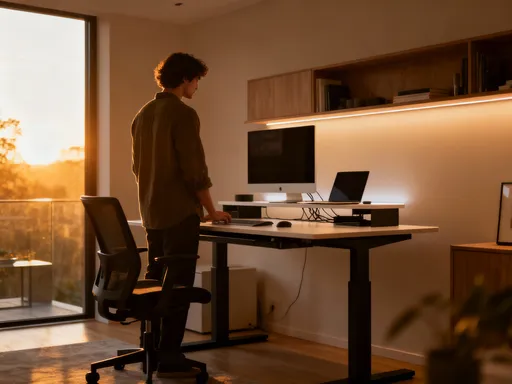
Then I invested in a smart sit-stand desk. It looks like a regular desk, but it rises and lowers with the touch of a button. I set it to remind me every 45 minutes to stand for 10 minutes. At first, I ignored the gentle chime. But over time, it became part of my rhythm. I take phone calls standing up, review documents while stretching, and even do quick shoulder rolls while waiting for a file to load.
Some models even come with posture sensors that alert you if you’re leaning too far forward or slouching. I paired mine with a simple app that tracks how much time I spend sitting versus standing. It’s not about hitting a perfect ratio—it’s about awareness. When I stand, I feel more alert. My circulation improves, and I breathe deeper. My kids even joke that I look like a 'standing superhero' during Zoom meetings.
This upgrade wasn’t just about physical health—it changed how I experience my workday. I feel more in control, more energized, and more connected to my body. And when you’re not fighting pain or fatigue, you can actually enjoy your work. It’s a small change that made a big difference in how I feel—not just during work hours, but throughout the entire day.
Seamless Tech That Disappears Into the Background
At first, I worried that adding more tech would make my life more complicated. More apps. More passwords. More blinking lights. But the opposite happened. By integrating my smart lighting, thermostat, speaker, and desk into one simple system, I actually reduced my mental load. Everything works together now, triggered by routines instead of constant commands.
I created a 'start work' routine that activates with a single phrase: 'Good morning, let’s begin.' Instantly, the lights brighten to a focus-friendly tone, the thermostat adjusts to my ideal temperature, the speaker plays a soft productivity playlist, and my phone silences notifications. My desk rises to standing height, ready for action. It takes less than ten seconds, and I’m set for the day.
There’s also a 'wind down' routine for the end of the workday. With a voice command, the lights shift to a warm, calming hue, the temperature cools slightly, and soothing music plays. My desk lowers, and my work apps close. It’s like a gentle signal that the workday is over—no more 'just one more email.'
The magic isn’t in the gadgets. It’s in how they work together to support me without demanding my attention. They don’t buzz, beep, or nag. They just know. And when your environment adapts to you instead of the other way around, you save energy—mental, emotional, and physical. That energy? I’d rather spend it on my family, my hobbies, or just a quiet cup of tea in peace.
Creating a Home That Cares
Looking back, I realize I didn’t just upgrade my home office—I redesigned my relationship with work and with myself. These changes weren’t about chasing the latest tech trends or showing off a 'smart' home. They were about asking a simple question: How can my space help me feel better? And then taking small, kind steps to make it happen.
Now, when I sit down to work, I don’t dread it. I feel supported. The lighting is gentle. The air is just right. The sounds around me are calm. My body feels strong. My mind feels clear. And when the workday ends, I can truly step away—no lingering stress, no unfinished mental loops. I’m present for dinner, for bedtime stories, for the quiet moments that matter most.
This is the real power of smart home technology—not flashiness, but thoughtfulness. Not control, but care. When your home responds to your needs before you even speak them, it feels like being understood. It’s not just a place where you work. It’s a place that helps you thrive.
So if you’re feeling drained, distracted, or disconnected in your home office, I want you to know: it’s not you. It might be your environment. And the good news? You don’t need a full renovation or a tech degree to change it. Start small. Try one upgrade. See how it feels. Because when your space works with you—when it listens, adapts, and cares—you’re not just working from home. You’re living well, right where you are.